Skin tags are caused by friction. Skin rubbing against skin, or against clothing and jewellery, over a long period. That is why they appear in folds and creases rather than randomly across the body.
The NHS notes that the cause is not always known. Repeated rubbing is the common thread. Age, weight, pregnancy and type 2 diabetes all raise the odds. There is a genetic element too. If your parents got them, you probably will.
They are harmless. That is the important part, and it is worth saying before anything else.
At our Rainford salon, Cryopen treatment is delivered by a registered children's nurse. That shapes how this article is written.
"As a registered children's nurse, I can also treat children with warts and verrucas, and there is no upper age limit to Cryopen."
Below: what causes skin tags, why some people suddenly get a lot of them, the removal options including the ones we do not sell, and the signs that mean you should see a GP rather than book a beauty appointment.
What causes skin tags?
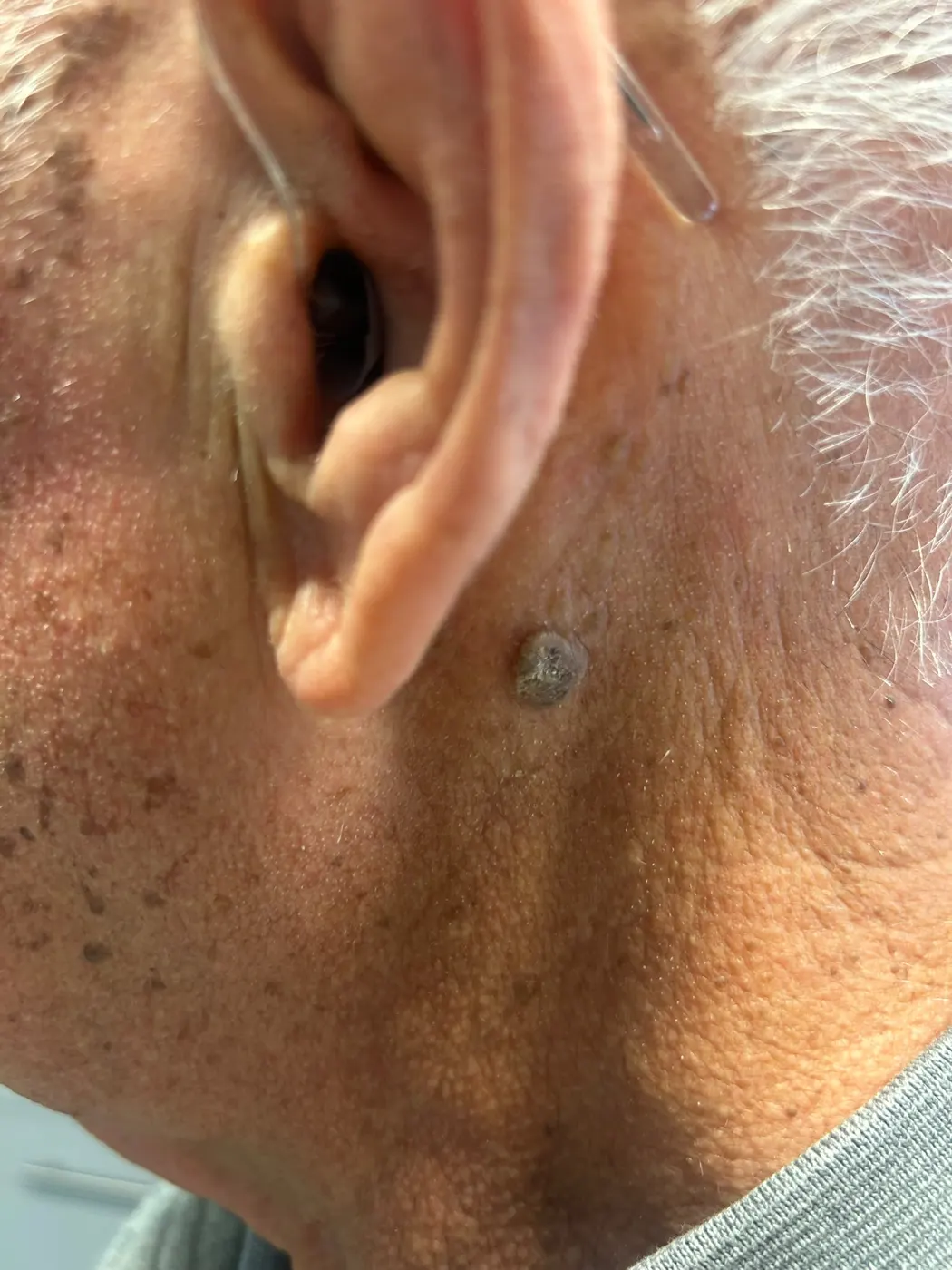
A skin tag is a small, soft growth of loose collagen fibres and blood vessels, wrapped in skin. It hangs off the surface on a narrow stalk. That stalk is why it moves when you touch it.
Friction is the trigger. Skin folding on skin, a collar rubbing, a necklace chain moving all day, a bra strap sitting in the same place for years.
The factors that make them more likely:
- Age. They become far more common from your forties onwards
- Genetics. A family history is one of the strongest predictors
- Carrying extra weight, which creates more folds and more friction
- Pregnancy, through hormonal change and skin stretching
- Insulin resistance, including type 2 diabetes
- Skin conditions that leave folds more prone to rubbing
The insulin link is the one most articles skip. The American Academy of Dermatology notes the association with insulin resistance.
This does not mean a skin tag is a diagnosis of anything. It means a sudden crop is worth mentioning at your next GP appointment.
Why they appear where they appear
Map the friction and you have mapped the skin tags.
The places we treat most often:
- The neck, usually where a necklace or a collar sits
- Under and around bra straps and the band
- The armpits
- The groin and inner thighs
- Under the breasts
- The eyelids, which is where people most want them gone
Shaving is an underrated contributor. Repeatedly dragging a razor over the same area of neck, underarm or bikini line adds friction on top of friction, and catching a tag while shaving is one of the most common reasons people finally book removal. If that is the pattern for you, reducing how often you shave at all is worth considering: laser hair removal and waxing both cut the number of passes over the same skin.
They cluster because friction is not evenly distributed. One strap, one chain, one seam does the same thing in the same place for years.
Eyelid tags are worth a separate word. They are the most common reason people come to us, because they are impossible to ignore in a mirror. They are also the ones you should never attempt at home, for reasons that should not need spelling out.
Skin tags on the neck are the single most searched location, and they are also the most treatable. They are usually small, accessible and clear of anything delicate.
Why am I suddenly getting so many?
A cluster appearing over a few months usually has a plain explanation.
Common triggers we see:
- Weight change in either direction, which alters where skin folds
- Pregnancy, with tags often appearing in the second and third trimesters
- A new habit or item of clothing, such as a work harness, a lanyard or a heavier necklace
- Perimenopause and menopause, through hormonal shift
- Getting older, which is unglamorous but the most common answer of all
Occasionally a sudden crop is worth mentioning to a GP. Particularly alongside increased thirst, fatigue or unexplained weight change.
That is not a reason to worry. It is a reason to have a conversation.
Are skin tags dangerous?
No. Skin tags are benign, meaning non-cancerous, and they do not turn into anything else.
What matters is being sure that what you have is actually a skin tag.
See a GP rather than a clinic if the growth:
- Changes size, shape or colour
- Has an irregular or blurred border
- Bleeds without being caught or knocked
- Itches, crusts or fails to heal
- Is more than one colour, or very dark
- Appeared recently and is growing quickly
Those features are associated with moles and skin cancers rather than skin tags. The NHS has guidance on moles and on melanoma. Cancer Research UK sets out the warning signs clearly.
We do not treat moles. If you come to us with one, we refer you to your GP or a minor surgery service. If anything at all concerns us during a consultation, we will ask your permission to speak to your GP before we do anything.
That is the honest boundary of what a clinic like ours should be doing, and we would rather state it plainly than have you assume otherwise.
Why home removal goes wrong
The at-home market is large and the methods are worse than people expect.
Tying cotton or dental floss around the base is the most common home remedy. It works by cutting off the blood supply.
It also commonly produces swelling, infection and days of real pain. The tissue dies slowly, and it does so unhygienically.
"I have had ladies and gentlemen who have tried to remove skin tags themselves by tying cotton around them. The cotton has got stuck, the skin tags have gone swollen, and it just prolongs the pain and discomfort for the patient."
Cutting one off with nail scissors risks bleeding that is harder to stop than you would think, particularly on the neck.
Freezing kits sold over the counter deliver a much less precise dose than clinical equipment. They freeze a wider area than the lesion itself.
On the face and neck, that can leave a pale or darkened patch where healthy skin was damaged.
The British Association of Dermatologists has warned about the risks of at-home cosmetic kits more broadly. The principle carries. Precision and assessment are the two things a home kit cannot give you.
The other problem is the one nobody mentions. A home kit does not tell you whether the thing you are removing is a skin tag.
Removal options, including the ones we do not offer
Worth knowing the full picture before you book anything.
| Option | How it works | Realistic notes |
|---|---|---|
| Leave it alone | Nothing | Entirely valid. They are harmless |
| GP removal | Minor surgery, ligation or freezing | Rarely available on the NHS for cosmetic reasons |
| Private minor surgery | Excision under local anaesthetic | Best for larger tags, leaves a small scar |
| Cryotherapy | Controlled freezing | What we offer, suits small and medium tags |
| Electrocautery | Burning the stalk | Effective, usually a dermatology clinic |
The NHS does not generally remove skin tags on cosmetic grounds. That is why most people end up looking privately, and it is worth knowing before you book a GP appointment expecting removal.
Sessions and cost at a glance
| Lesion type | Typical sessions | Cost guide |
|---|---|---|
| A single skin tag | 1, occasionally 2 | £60 |
| Multiple small lesions | 1 to 2 | £100 |
| Warts | 4 to 5 | Quoted at consultation |
| Verrucas | 4 to 5, sometimes more | Quoted at consultation |
| Delicate or intimate areas | More, spaced further apart | Quoted at consultation |
Larger areas are priced bespoke, based on lesion size, number and canister usage.
How Cryopen removal actually works
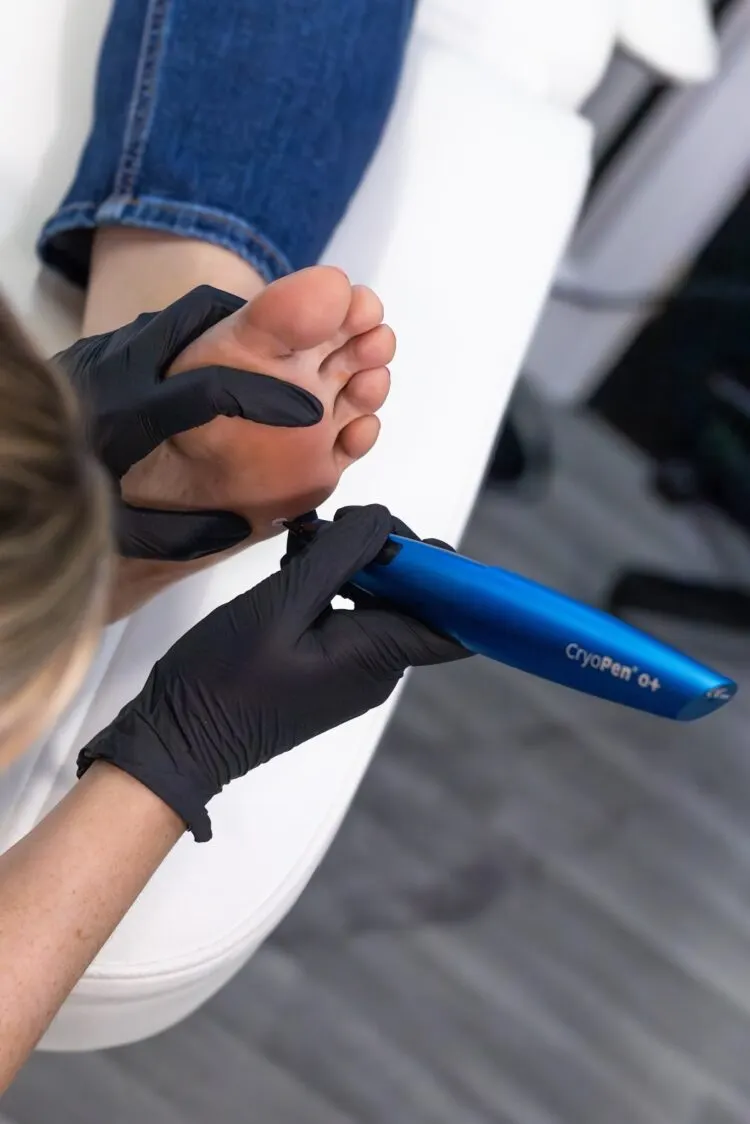
Cryopen is a medical-grade cryotherapy pen. It delivers a controlled freeze, thaw, freeze cycle to a very small area, damaging the lesion so the body clears it naturally.
The precision is the point. A home freezing spray covers a wide area. Cryopen delivers the dose to the lesion and very little else.
What happens at the appointment:
- Consultation, medical history and clinical photographs
- Assessment of whether Cryopen is right for the lesion at all
- Treatment, a few seconds per lesion, feeling intensely cold
- Aftercare advice, and a review booked for two weeks later
The whole visit takes around 20 minutes. Numbing cream is not usually needed for a single lesion, though delicate areas are more tender.
Afterwards the area may be red and a little itchy, which is normal. Over one to two weeks the lesion typically blisters, scabs, crusts and falls away, leaving fresh skin.
Skin tags usually need one session. Occasionally two.
"Sessions vary depending on the lesion to be treated. Generally skin tags just require one session, maybe two."
Viral lesions such as warts and verrucas take longer, often four to five sessions. You are treating a virus rather than a growth.
You can shower, bathe and go to the gym as normal.
Two cases from the clinic
Numbers are more useful than adjectives, so here are two real ones.
A gentleman came to us with roughly fifty skin tags under each armpit and across his neck and sides. Working through his history, the cause was clear: his job involved wearing harness equipment. All of them were cleared across two sessions, with very minimal discolouration afterwards.
"He was no longer embarrassed to take his T-shirt off when he went swimming or on hot days. Something so small can really affect your confidence."
The second was a child with cystic fibrosis, so at greater risk of infection, whose verrucas had multiplied despite his mother trying every home treatment available. Those took around six sessions rather than the usual four to five. Eighteen months on, they have not come back.
That second case is the honest counterweight to the first. Skin tags are usually quick. Viral lesions are not, and anyone promising you otherwise is guessing.
Full detail, including everything we treat beyond skin tags, is on our Cryopen page.
Who Cryopen is not suitable for
This section exists because a clinic that only lists who a treatment suits is not telling you the whole thing.
We will ask you to speak to your GP first, or we may decline to treat, if:
- You are pregnant. Cryotherapy is not generally indicated during pregnancy
- You have Raynaud's and the lesion is on your hands or feet
- You have darker Fitzpatrick skin, types IV to VI. Cryopen is still safe, but carries a slightly greater risk of temporary hyperpigmentation, which we discuss at consultation
- The lesion sits somewhere that needs particularly careful assessment
- You want a mole removed, in which case we refer rather than treat
None of those are permanent barriers. They are conversations to have before treatment rather than after.
What it costs and what to expect
Our Cryopen prices are £60 for a single lesion, £100 for multiple small lesions and £150 for larger areas. Your nurse confirms which applies at your consultation, based on the size and number of lesions.
Cryopen at our salon is delivered by a registered children's nurse, so there is no upper age limit and we can safely treat children with warts and verrucas.
A review appointment two weeks later is included. We would rather see you sooner if anything concerns you.
If you are treating several things at once, it is worth asking at consultation. Multiple lesions in one visit usually works out better than separate appointments, both for cost and for healing.
Final thoughts
Skin tags are harmless, and the honest advice for a lot of people is to leave them alone. If yours are not catching on anything and you do not think about them, there is no medical case for removal.
Remove them when they snag on a necklace, catch when you shave, or you simply do not want to look at them any more. Those are good enough reasons on their own.
What we would push back on is the home kit. Not because we sell the alternative, but because the two things a kit cannot do are the two things that matter: deliver a precise dose, and confirm what it is you are freezing.
The one thing worth taking seriously is the boundary. Anything changing, bleeding, growing or irregular goes to a GP first, not to a clinic. Being certain what you are treating matters more than how quickly you treat it.
Have a look at what else we treat if you are considering more than one thing, or see real client results before you decide. Clients often pair a Cryopen appointment with lash or brow treatments to save a trip. If you are working on skin texture or scarring at the same time, medical-grade microneedling can be booked in the same visit, and our facials cover wider pigmentation concerns.
Book a Cryopen consultation at Hannah Clarke Advanced Skin and Beauty, 38 Church Road, Rainford, St Helens. Book online, call 07514 307 552, or send us a question first.
This article is general information, not medical advice. Any lesion that is changing, bleeding or causing concern should be assessed by a GP.